The Illusion of Time in Thinking
“What if the present does not create the reaction — it only brings it to the surface?”
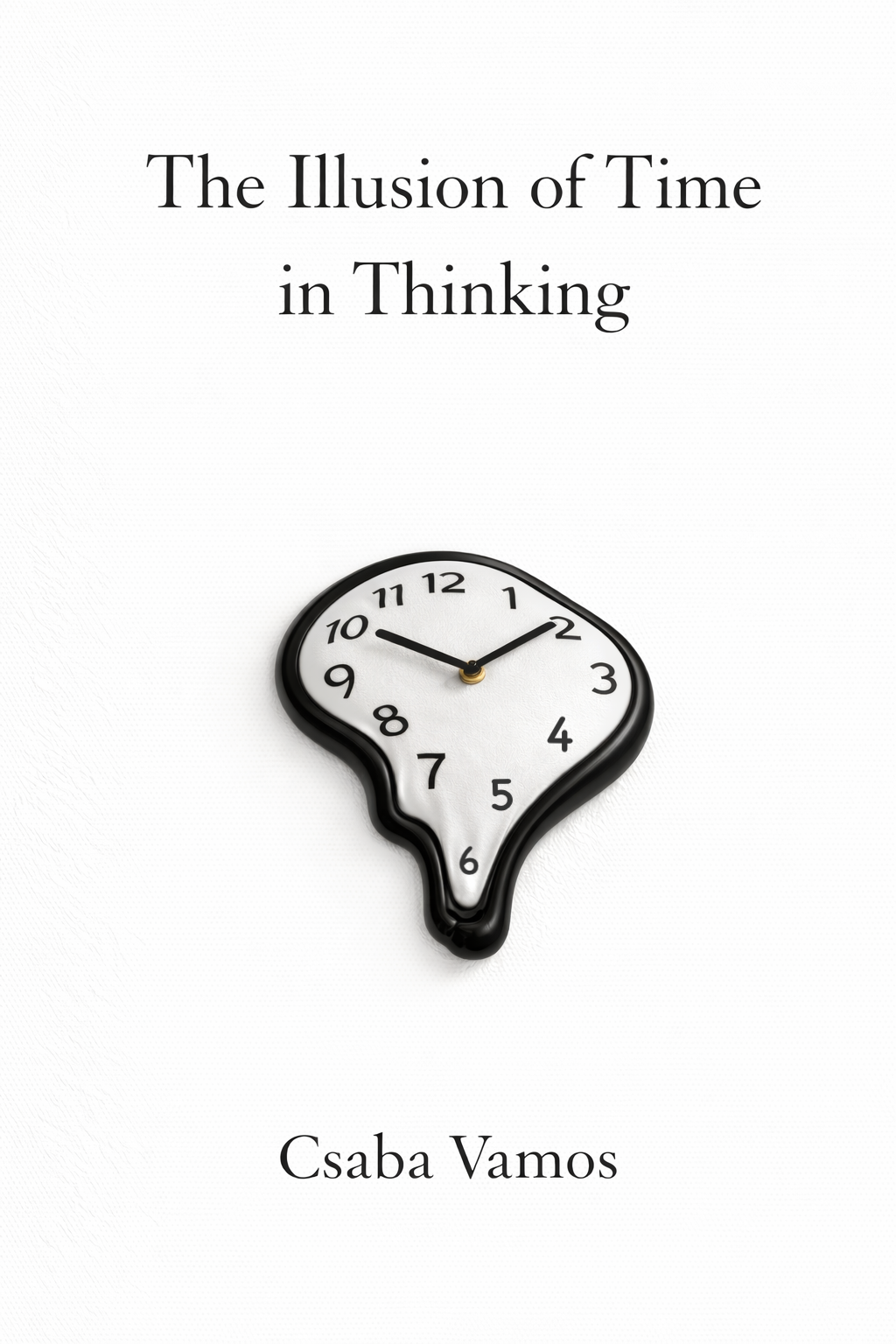
A journey through thought and time
The Illusion of Time in Thinking invites you on a journey of thought, where the classical past–present–future order breaks down, and human behavior becomes visible from a new point of view.
From Newton’s time to Einstein’s point of view
A historical turning point, used as a parallel for human behavior.
Isaac Newton formulated the idea of absolute time in 1687: time flows evenly on its own, independent of external things.
For centuries this idea shaped how we picture time: the past is behind us, the present is happening now, the future lies ahead.
In 1905, Einstein showed this picture isn’t accurate in every situation. Time doesn’t pass the same way for every observer, and perspective fundamentally shapes how events are ordered.
The book uses this historical turn as a parallel for understanding human behavior: what if past, present and future don’t always operate in simple order within us either?
Reaction as a Trace
The book treats human reactions as traces. It does not analyze what we feel; instead, it asks where a reaction may come from.
It asks: what logic from the past may be present within it?
When Playing Cards Become a Scene
In one common method, a person memorizing a deck of cards assigns a person, an action, and an object to each card in advance. This turns the cards into short scenes, which are then placed along a familiar route.
During recall, they mentally follow the route, and the scenes return in order. In the same way, we remember what happened to us yesterday on the way to the store.
When the Present Merely Brings Something Back
This parallel gave rise to the book’s conceptual model:
What if a situation in the present similarly brings back a reaction that formed earlier?
Someone memorizing the cards knows what they placed along the route and why. Most of us do not know which earlier experience a present situation brings back within us.
From this perspective, a reaction that seems strange in the present is not necessarily a mistake, but a response learned long ago.
A Scent and an Old Memory
That is why a scent can bring a childhood memory to the surface. We smell it now, but the experience connected to it happened long ago: in a single moment, we can travel back decades in time.
This book is for readers who are interested not only in what we feel or how we react, but also in what may be at work behind our reactions.
Everyday time is not the same as the time in which our thinking and reactions operate. Time in the classical sense — past, present, future — is useful for history, for a clock or a meeting, but misleading when we try to understand how our thinking works.
Get the book
The English edition is available as an ebook from these stores.
Prices and availability may vary by platform in external stores.
Structure of the book
Eleven chapters — one line of thought.